
Herd compliance: algorithm addiction.
What happened when searching replaced browsing.

Hi everyone,
I thought I’d finish up these musings on Herd Compliance with the sneakiest one we have to deal with, a mode of enforcing compliance you can’t alway detect: online algorithms. There are a couple of levels of sneakiness here. We typically imagine algorithms work by feeding us what we want, in abundance, with just enough something-else to nudge our worldview in a particular direction…
Which got me to thinking about two examples: the way we were taught to “color inside the lines” and — more alarming — the disappearance of library card catalogs.
I know, weird right? Seriously, stay with me.
Coloring inside the lines.
To fight Herd Compliance, that is to say, coloring outside the lines to protest a culturally sanctioned world view, is tough. We all find ourselves uncomfortable with some of the inherited biases that condition thinking and behavior. The Color Line, the Gender Line and — the one we’re never supposed to talk about — the Economic Line, are typically right there for everyone to see — even if it’s hard for some folks.
You’re familiar with the standard Herd injunctions: “Don’t get out of line!” “Don’t you cross that line!” and, of course, “Stay in line!”
Most of those inherited Cultural-Coloring-Book lines needed some serious crossing, and the established lines are pretty damned clear when it comes to race and gender. Society kept bumping up against them and clearly saw what lines needed to be crossed. (It’s easy to be cynical, but race and gender have been rewritten dramatically in the last 60 years, even if there’s still miles to go. The arc is long, but it’s still bending toward justice. Still, economics? Not so much yet. But that’s another soapbox.)
When the lines are obvious it’s pretty straight forward, but what if you can’t see the lines? What if something is always nudging people, quietly, sneakily, unconsciously, back inside the lines? Hint: yeah, it’s algorithms.
We’re in a different coloring-book-universe nowadays: what were once our social lives have been absorbed into the Borg collective of social media. We’ve moved from living socially to being socially media-ted. We used to have lives we lived. Today our lives have been relocated to social media and social media mediates our lives for us — and to us. Algorithms nudge us into socially acceptable compliance.
Ah, the algorithms…. we don’t like them because they bubble-ize and silo-ize our social media feeds with dopamine candy in service to the profit margins of advertisers foreign and domestic. But, of course, at some level, people do like them…. and that’s the problem.
Back in the analog daze, uh days, the siphons of attention-acquistion weren’t as... I guess I want to say as “efficient.” It took time to mobilize compliance. Advertising, and especially the changes in advertising that came in with Edward Louis Bernays, really cranked it up. He was the guy largely responsible for revolutionizing advertising’s entire paradigm from selling people what they needed, to selling people what they wanted — ushering in the era of artificially created demand and manufactured consent.
That took time. It’s all automated now and tailored to what social media is able to extract and triangulate about your desires, wants, and needs — conscious or not.
[BTW, if you haven’t seen it, go watch The Century of the Self. (here’s the wikipedia overview.) It’s a BBC documentary available on YouTube about the shift in advertising and the creation of the modern herd mentality. I used it in class for years and it remains highly disturbing…. we’re living in it today.]
— but wait, there’s more.
And this is a bit weirder, and scarier too, because it seems utterly mundane — or for the Hannah Arendt fans out there, I should say “banal.”
The disappearance of library card catalogs and the algorithm we can’t see: when searching replaces browsing.
Card catalogs? What?
No really, this suggests how sneaky herd compliance has become.
Do any of you remember wandering through the stacks in a library looking for a book, but ending up sitting on the floor with a book you found by accident? (Does that even happens anymore?)
If you never had this experience, then the algorithm already has your number.
Here’s a real life parable: back in the 90’s our campus library replaced the old card catalogs with the now ubiquitous, searchable, database.
The old card catalogs — here’s a link for those of you who have never seen one — consisted of three huge filing cabinets filled with 3 x 5 cards in little drawers organized by subject, author, and title, respectively. When you wanted to find a particular book, you would browse through these cards, the way you pick through vinyl albums at the record store, to find the one you wanted. If you had a subject you were interested in, you’d look in the subject catalog under that heading; if you knew the author, you could look them up in the author catalog; and if you knew the text you were looking for, you’d look in the title catalog. Each card had a library call number on it indicating where in the library you could find that book. Then, you’d plunge into the stacks to track down the book with that number.
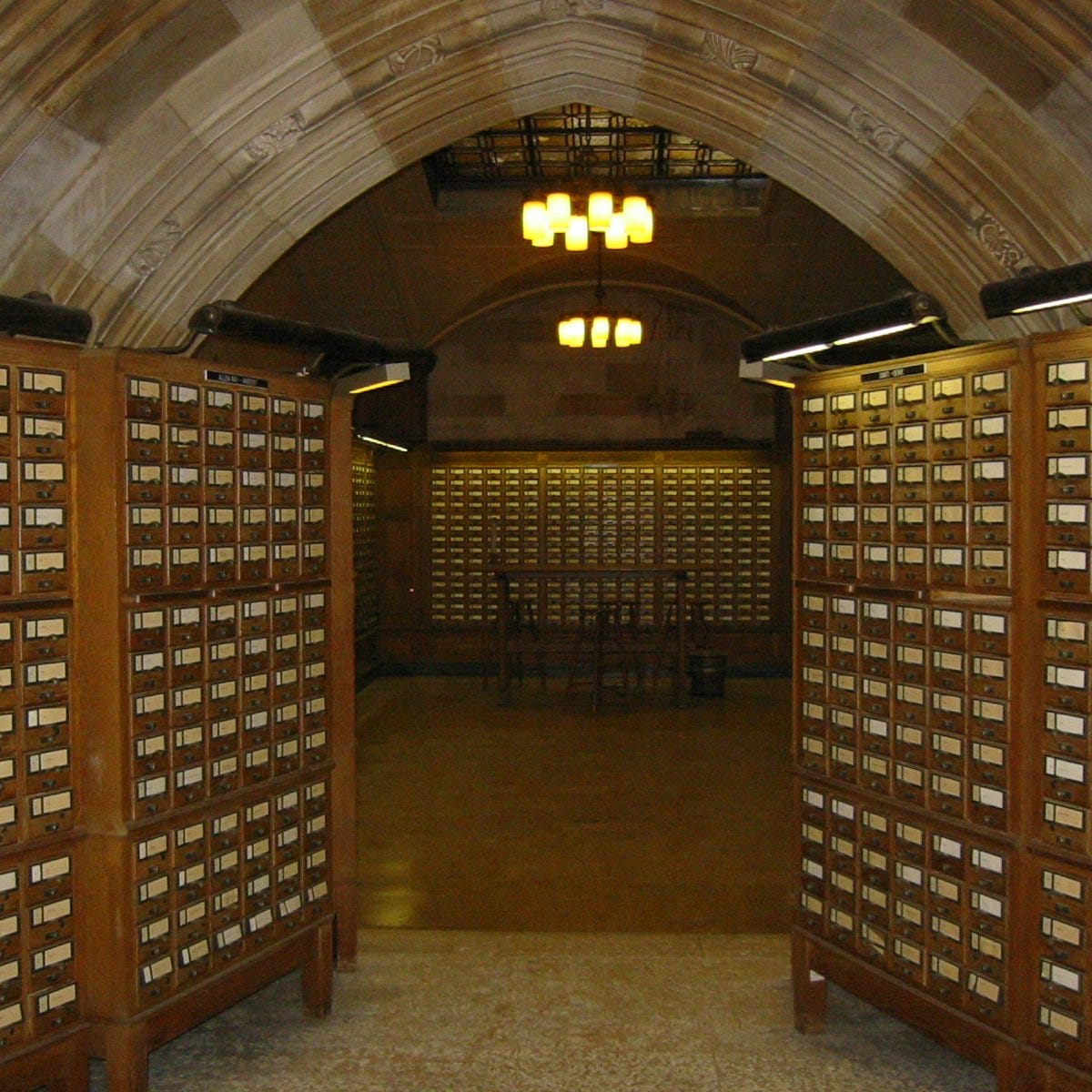
Tada.
Now, back in those ancient days, one of the best things that could happen in a library — and this was especially true for people like me who are generally lazy and uninterested in doing work someone else assigned — was going into the stack, wandering down the aisle, and stumbling by accident into something completely irrelevant-but-fascinating. Such discoveries were nearly always books that had nothing to do with your assigned topic but which, for reasons mysterious, grabbed your attention. At which point you’d end up sitting on the floor between the stacks and digging into them instead of into your assigned topic.
Like this.

For those of us who grew up in libraries, finding stuff by accident was actually the most fun you could have in a library — that is, finding stuff you weren't looking for.
I’m going to repeat that: the best part was finding the stuff you weren’t looking for.
[I’m also pretty sure at this point in my life that finding stuff you weren’t looking for is the single MOST IMPORTANT THING THAT CAN HAPPEN TO YOU IN A LIBRARY … or in life. Just saying.]
Anyway, technology rolled on and, as computers showed up everywhere, card catalogs were replaced with searchable databases.
And so it came to pass [this really happened] that, at one of our faculty meetings, the chief librarian told us they'd be swapping out the old card catalogs.
I raised my hand and asked them not to do it.
They asked, quite rightly, why anyone would want to keep a clunky outmoded filing system of 3x5 cards, when we could replace that with a sizzlingly modern electronic version that always gives you — and here’s the selling point — exactly what you're looking for?
I said: "Well, if you go with searching instead of browsing the stacks, you’ll only ever find what you're looking for and you'll never find what you aren't looking for.”
The librarian was flustered and asked "but why would you want to find something you weren't looking for?”
And I replied with something stupid like, “isn’t that the whole point of education?”
…which, it is.
Anyway, the card catalogs were tossed out, “browsing” was replaced by “searching”, and finding what-you-weren’t-looking-for was replaced by finding-what-you-wanted.
See it now?
The algorithms running our social media feeds or programming the evening news with what we want, make sure we always find exactly what we want to find — and that provides the dopamine rush and the addictive endorphin dump we get from having our biases confirmed.
And this way the herd, our society, culture, and worldview is mooooooooved to believe, and think, and act — and vote — in compliance.

And here we are.
If you’ve enjoyed the hijinx here at the Motley Cow please comment and then share it out with your friends and relations.
The Motley Cow project is reader-supported, and that means you!
If you’ve enjoyed the content, please consider buying me a cup of coffee by upgrading to a supporting member.
Little Free Libraries, Algorithm Free !
No. Not for me. I always went to the library and always will search for accidents. I've never wandered into a library looking for a specific book. You might want to check Deleuzes seminal late essay "Post-script for Societies of Control." 1992. We've moved on from Foucault's Victorian-era disciplinarian society to one of control, where we participate in our own compliance, actively.